Best Battery for Solar Panel in Pakistan 2026
The best battery for a solar panel in Pakistan is not a single brand or model, it depends on your budget, how much backup you need, and whether you are willing to trade a lower price today for higher costs later. This guide compares every real option available in Pakistan in 2026, tubular, gel, and lithium, with actual prices, real lifespans, and a full cost breakdown, so you can pick based on numbers instead of guesswork or a shop dealer’s recommendation.
In This Guide
- Quick Answer By Budget
- Full Comparison Table
- Tubular Batteries: The Budget Standard
- Gel Batteries: The Low-Maintenance Middle Ground
- Lithium Batteries: The Long-Term Investment
- Best Brands for Each Type
- Mistakes People Make When Buying
- Frequently Asked Questions
Quick Answer By Budget
If your battery budget is under Rs. 100,000, go with a tubular deep-cycle battery. It is what most Pakistani homes already run, and it handles daily solar charge-discharge cycles far better than a regular UPS or car battery. If your budget is Rs. 150,000 to 300,000 and you want to buy once and forget about it for a decade, go lithium. If you want something in between, no maintenance but not quite lithium money, a gel battery is worth a look, though it is a smaller, less common market in Pakistan. Whatever your budget, never use a standard flat-plate UPS battery for solar. It is not built for daily deep discharge and will fail within months.
Full Comparison Table
| Factor | Tubular | Gel | Lithium |
|---|---|---|---|
| Price (per usable ~2.5kWh) | Rs. 40,000 – 50,000 | Rs. 50,000 – 60,000 | Rs. 90,000 – 130,000 |
| Safe discharge depth | 50% | 70-80% | 90-95% |
| Real-world lifespan | 4 – 6 years | 10 – 15 years | 8 – 12 years |
| Maintenance | Monthly water top-up | None | None |
| Weight (per ~2.5kWh usable) | 75 – 100 kg | 70 – 90 kg | 25 – 30 kg |
| Availability in Pakistan | Widely stocked everywhere | Limited, mostly special order | Growing, sold through solar dealers |
Tubular Batteries: The Budget Standard
A tubular battery uses tube-shaped plates that hold more active material than a flat-plate design, which is why it survives daily solar cycling far better than a normal battery. The catch is that you should only drain it to about 50% of its rated capacity. Push past that regularly, and the plates degrade fast, cutting a battery rated for 5-6 years down to 1-2. Prices range from Rs. 22,000 for a 150Ah Phoenix TX 1800 up to Rs. 85,000 for a 250Ah AGS Tall Tubular, depending on brand and capacity. For most homes, two to four batteries wired together into a bank gives 6-8 hours of backup. See our Tubular Battery Price in Pakistan guide for the full brand-wise breakdown.
Gel Batteries: The Low-Maintenance Middle Ground
Gel batteries use a thick, sealed electrolyte instead of liquid acid, so there is nothing to top up and they handle heat better than tubular. A genuine Narada gel battery is rated for 10 to 15 years, which is longer than even lithium in some cases. The trade-off is availability, gel batteries are not stocked at every corner shop in Pakistan the way tubular batteries are, and pricing is less standardized since most sellers quote per order rather than publishing a fixed list. Expect to pay Rs. 50,000 to over Rs. 100,000 depending on capacity. Full details are in our Gel Battery Price in Pakistan guide.
Lithium Batteries: The Long-Term Investment
A lithium (LiFePO4) battery costs 3 to 6 times more than a tubular battery of similar rated size, but the comparison isn’t fair on rated size alone. Because lithium allows 90-95% safe discharge versus tubular’s 50%, a 5.12kWh lithium battery gives you almost the same usable power as two to three tubular batteries combined. Add in an 8 to 12 year lifespan with zero maintenance, and the total cost over 10 years often comes out close to, or even below, what you’d spend replacing tubular batteries two or three times. A 5.12kWh lithium battery from Narada or Inverex costs Rs. 180,000 to 260,000 in Pakistan right now. Full pricing is in our Lithium Battery Price in Pakistan guide, and the complete 10-year cost math is worked out in our Lithium vs Lead Acid Battery guide.
Best Brands for Each Type
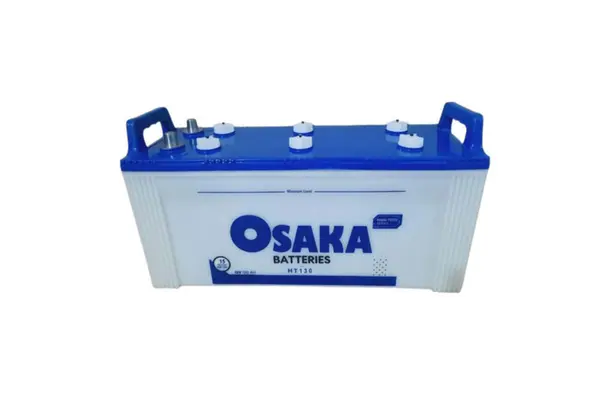
For tubular, Phoenix and AGS are the two most trusted names for solar use. Phoenix also offers a lithium upgrade path within its own product line if you decide to switch later, while AGS Tall Tubular models are built for longer backup and suit bigger homes or light industrial use. Exide and Osaka are solid mid-range alternatives with wide dealer coverage across every major city. For lithium, Narada and Inverex are the most commonly sold brands through solar equipment dealers, typically in 48V or 51.2V configurations built for hybrid inverters. For gel, Narada is again the main name available in Pakistan, sold mostly through larger solar dealers rather than general battery shops.
Mistakes People Make When Buying
- Buying a normal UPS or car battery for solar use. It is not built for daily deep discharge and will fail within a few months of solar cycling.
- Choosing a brand based on advertising alone instead of checking the Ah rating against actual power needs, worked out from real appliance wattage.
- Skipping the monthly water top-up on a tubular battery, which is the single biggest reason these batteries die years before their rated life.
- Comparing battery prices using the rated Ah number alone, without accounting for how much of that capacity is actually safe to use.
- Not asking for a warranty card and checking the manufacturing date sticker at the time of purchase.
Frequently Asked Questions
Can I use any battery with my solar panels?
No. Solar panels charge and discharge the connected battery every single day, sometimes multiple times if the weather is cloudy and clears up. Only deep-cycle batteries built for this, tubular, gel, or lithium, can handle that pattern long-term. A regular car battery or a light-duty UPS battery will degrade and fail within a few months if used this way, since they are designed for occasional, shallow discharge rather than daily deep cycling.
Is lithium really worth the extra money for solar in Pakistan?
If you plan to run your solar system for 8 or more years, yes, in most cases. Lithium lasts roughly twice as long as tubular and lets you use 90-95% of its rated capacity versus tubular’s 50%, so you often need a smaller, lighter lithium unit to match the backup of a larger tubular bank. Once you factor in that a tubular bank typically needs replacing once or twice over the same period, the total cost gap narrows significantly, and in many cases lithium ends up costing about the same or less over a full decade.
What size battery do I need for a small home solar system?
For basic loads like lights, fans, and a router, a single 150Ah to 200Ah tubular battery is usually enough for 4-6 hours of backup. If you also want to run a fridge, plan for at least two batteries wired into a bank, or a single lithium battery in the 2.5 to 5kWh range, which gives similar or better usable backup in a much smaller, lighter package.
Should I buy tubular now and upgrade to lithium later?
This works, but only if you plan for it. Lithium and tubular batteries should never be mixed in the same bank, since they charge differently and mixing them damages both faster. If you go tubular first, treat it as a full replacement decision later, not an add-on, and budget for the eventual lithium purchase as a separate cost rather than expecting to reuse any part of your tubular setup.